Inquiry-based learning has always been about making thinking visible. At its core, it encourages students to ask questions, investigate ideas, weigh evidence, and explain their reasoning. That goal has not changed. What has changed is the learning environment.
In today’s classrooms, students have easy access to generative AI tools that can produce answers, explanations, and polished outputs in seconds. This creates a new tension for educators: when answers are readily available, how do we know whether inquiry—and learning—actually happened?
This moment does not signal the end of inquiry-based learning. Instead, it calls for a more intentional approach; one that aligns inquiry with assessment methods capable of revealing how students think, not just what they submit.

Table of Contents
What Research Says About Inquiry-Based Learning
Decades of educational research show that inquiry-based learning supports deeper understanding when students actively construct knowledge through questioning, investigation, and reflection. Well-designed inquiry has been linked to:
- stronger conceptual understanding beyond memorization
- improved critical thinking and reasoning skills
- higher learner engagement and motivation
- better transfer of knowledge to real-world contexts
At the same time, research is clear about an important condition: inquiry works best when it is guided. Completely unguided inquiry can overwhelm learners, particularly those who are still developing foundational knowledge. Structure, scaffolding, and timely feedback are essential.
This insight becomes even more important in the age of AI. When students can generate instant answers, inquiry risks becoming superficial unless educators can observe and assess the reasoning process itself.
Key insight: inquiry is most effective when teachers can see how students reason, not just what answer they arrive at.
Where Generative AI Complicates Inquiry
Generative AI does not undermine inquiry by default, but it does expose weaknesses in how inquiry is often assessed. Three challenges appear consistently in classrooms:
- Limited visibility into thinking
Teachers may receive well-written outputs without insight into the student’s reasoning process. - Answer-first behavior
Students may bypass exploration and investigation, relying instead on AI-generated conclusions. - Assessment mismatch
Traditional written submissions no longer reliably reflect individual understanding.
The issue is not the presence of AI itself. It is the lack of assessment methods that surface student thinking.
Inquiry-Based Learning: Then and Now
| Traditional Inquiry | Inquiry in the Age of AI | |
| Student Output | Written responses and reports | Polished AI-assisted submissions |
| Teacher Visibility | Partial view of thinking | Risk of hidden reasoning |
| Main Challenge | Time and scaffolding | Authenticity and assessment |
| What’s Missing | — | Clear evidence of how students think |
| What Matters Most | Final answers | Reasoning, explanation, and justification |
Reframing Inquiry-Based Learning for the AI Classroom
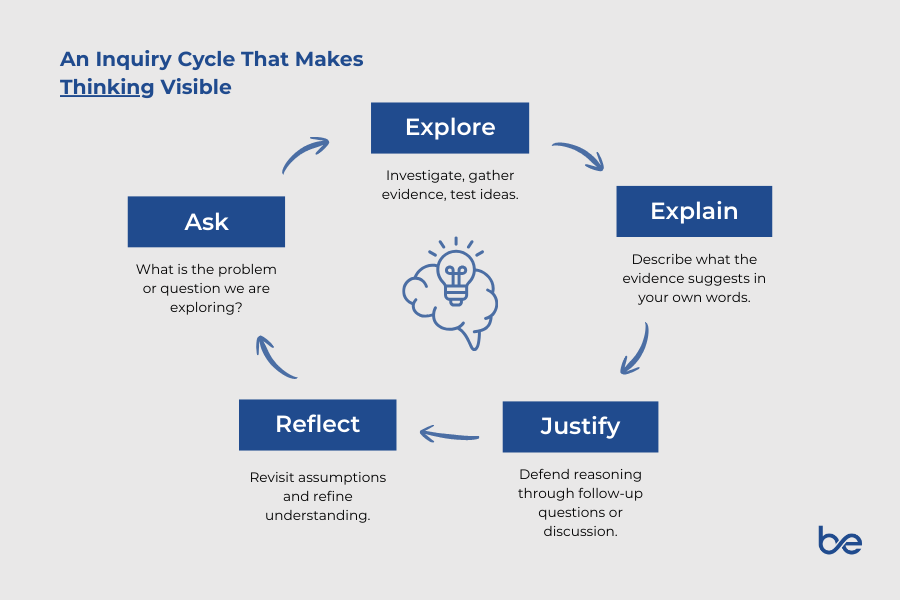
To remain meaningful, inquiry-based learning must shift emphasis from polished products to observable processes. This does not require abandoning written work, but it does mean complementing it with evidence that captures reasoning.
Across research and classroom practice, several approaches consistently support this shift:
- asking students to explain and defend their ideas
- using follow-up questions to probe understanding
- designing scenarios that require interpretation rather than recall
- embedding reflection checkpoints throughout the inquiry cycle
In this framing, AI can still play a role—as a tool for brainstorming, language support, or simulation—without becoming a shortcut that replaces thinking.
Why Voice and Explanation Matter in Inquiry
One of the clearest findings from inquiry-based learning research is that understanding becomes visible when learners explain ideas in their own words. Spoken explanations, in particular, can reveal:
- conceptual gaps that written responses may hide
- reasoning patterns and misconceptions
- differences between confidence and guesswork
When students articulate how they arrived at an answer, teachers gain richer insight into learning. Inquiry-based learning, paired with opportunities for explanation, shifts assessment from asking “What did you submit?” to “How did you arrive at this?”
This is especially relevant in AI-enabled classrooms, where explanation helps distinguish genuine understanding from generated output.
Designing Inquiry Tasks That Work With AI
Inquiry-based learning tasks remain effective in the age of AI when they are designed with assessment in mind. Strong tasks tend to share three characteristics:
1. Questions that require interpretation
Prompts should invite judgment, comparison, or application—rather than a single correct answer.
2. Checkpoints that capture reasoning
Students should explain assumptions, choices, or evidence before submitting final outputs.
3. Assessment that values thinking
Evaluation should prioritize clarity of reasoning, coherence of explanation, and responsiveness to follow-up questions.
These design choices reduce overreliance on AI-generated text while preserving the exploratory spirit of inquiry.
What This Means for Teachers and Schools
Inquiry-based learning in the age of AI is already a classroom reality. The practical question is no longer whether AI should be allowed, but how inquiry can be redesigned so learning remains human-centered.
Schools that navigate this transition well tend to:
- clarify acceptable AI use at different stages of inquiry
- adopt assessment methods that make thinking visible
- support teachers with tools that simplify, rather than complicate, assessment
The goal is not surveillance or control. It is alignment—between pedagogy, evidence, and how learning is understood.
Closing: Inquiry Is Still the Goal
Inquiry-based learning was never about producing perfect answers. It has always been about curiosity, reasoning, and meaning-making.
In the age of AI, inquiry does not lose its relevance. It becomes more intentional. When assessment methods evolve to reveal how students think, inquiry-based learning remains one of the most powerful ways to support deep and lasting understanding.
References
- Qablan, A., Alkaabi, A., Aljanahi, M. H., & Almaamari, S. A. (2024). Inquiry-Based Learning: Encouraging Exploration and Curiosity in the Classroom. IGI Global. (Open-access)
- National Research Council. (2000). Inquiry and the National Science Education Standards.
- Bybee, R. et al. (2006). The BSCS 5E Instructional Model.
- Khalaf, B. K., & Zin, Z. B. (2018). Traditional and inquiry-based learning pedagogy: A systematic review.